
Leadership facilitates gameplay—it doesn’t dictate it.
-
Every full member is an Operator.
This is intentional.
It reinforces a simple truth:
We are all players first.
As an Operator, you:
Participate in events
Build Merit automatically
Have no administrative obligations
If you just want to show up, play, and contribute—this is your role.
Operators are the backbone of JTF 501.
-
NCO — Gameplay Facilitators
NCOs are experienced members trusted to help facilitate smooth gameplay.
They may:
Create and lead events
Mentor newer players
Coordinate elements during operations
Support tactical execution
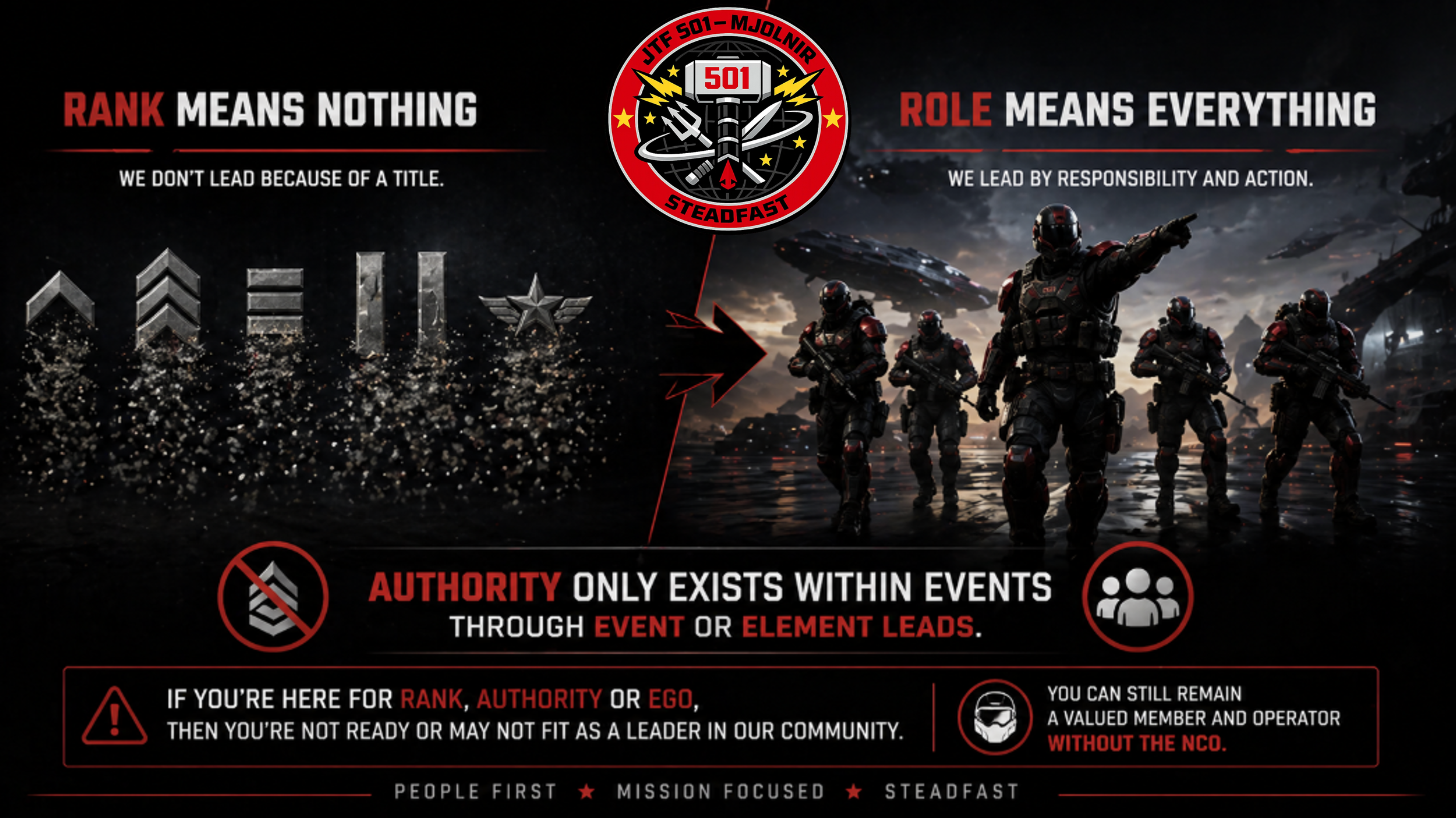
Authority in-game exists only during the assigned event.
If you are not the designated lead, you do not command.
Authority does not persist outside the event.
-
Specialists are recognized for skill and experience within specific gameplay areas.
They:
Teach and mentor
Advise during planning
Influence through competence
Elevate team performance
Specialists do not outrank anyone.
Specialist Domains
General / Multi-Domain
OMN → Multi-role / all domainsCombat & Operations
AIR → Air / flight
GRD → Ground / FPS
FLT → Fleet / multi-crew
OPS → General operations
MED → MedicalIndustry & Economy
IND → Industry
MNR → Mining
SAL → Salvage
LOG → Logistics
TRD → Trade
SUP → SupportSkill ≠ authority.
-
JUNIOR OFFICER — Stewards of Structure
Junior Officers support both gameplay and organizational stability.
They may:
Lead events
Assist planning
Support infrastructure
Maintain consistency
This role reflects stewardship—not prestige.
-
SENIOR OFFICER — Organizational Stability
Senior Officers focus on long-term health and direction.
They:
Maintain alignment and standards
Protect culture
Resolve issues when needed
Support continuity
They are not “higher players”—they carry greater responsibility.
-
COUNCIL — Oversight & Stewardship
Council Members support governance and long-term direction.
They:
Review proposals
Provide strategic input
Participate in decisions
Protect organizational balance
They do not command gameplay.
Their responsibility exists at the organizational level—not in moment-to-moment play.
STRUCTURE & RECOGNITION
How JTF 501 organizes roles, participation, and recognition across the community.
JTF 501 uses a simple framework to organize gameplay, support coordination, and recognize participation.
These systems exist to provide clarity—not control.
There are no mandatory requirements, no enforced pathways, and no barriers to participation.
OUR APPROACH TO STRUCTURE
Structure in JTF 501 is designed to support the experience—not define it.
We use roles, ranks, and systems to:
organize gameplay
enable coordination
recognize contribution
But none of these systems restrict how you play.
Structure supports gameplay—it doesn’t control it.
ROLES
Roles in JTF 501 define responsibility within the organization—not authority over others.
They exist to support coordination, enable gameplay, and maintain a strong, low-friction environment.
AUTHORITY = RESPONSIBILITY
Authority roles are not rewards or status symbols.
They are responsibility assignments.
They exist to:
Coordinate events
Support members
Maintain structure
Protect culture
Reduce friction during gameplay
These roles are granted based on:
Experience
Maturity
Reliability
Trust
Willingness to contribute
Not time served.
Not rank.
Not ego.
HOW ROLES WORK IN PRACTICE
Roles provide structure—but they do not define how you play.
Authority exists only when needed, and only within context.
Outside of that, we are all Operators.